
To start, tell us a little about yourself. Where are you from, and what brought you from Italy to Granada?
My name is Nicolás, I’m Italian and I’m a yoga instructor. But I’m not only a yoga instructor- I’m also a geologist. In fact, it was my passion for geology and the environment that first brought me to Spain, and then, for love, I moved further south to Granada, Andalusia.
How did your relationship with yoga begin, and what led you to make it such an important part of your professional life?
My journey with yoga began in 2014, following an injury to my ankle and calf. What started as a tool for physical recovery gradually transformed into a consistent daily practice that had a profound impact on my physical, mental and emotional well-being. It became a journey of growth, self-care and discovery that is still ongoing and that I continue to walk every day.
Through yoga, I learned to listen to my body, respect its limits and work consistently to improve. I overcame my fear of being judged, stopped comparing myself to others and understood that every body is unique and evolves at its own pace. Over the years and through my practice, I also decided to dedicate myself to teaching, as a way of supporting people in their own journey of emotional discovery and improving their physical and mental well-being, while helping others understand how important self-love and respect for our bodies are.
You focus particularly on gentle and mindful yoga. What does this approach mean to you, and what makes it different from other types of yoga?
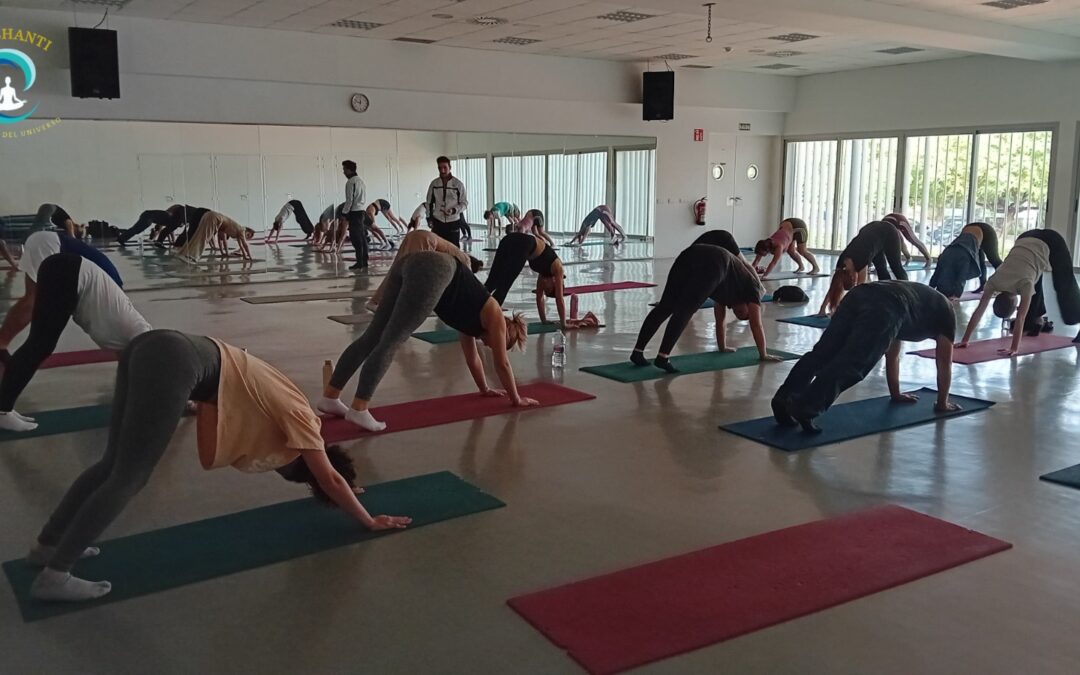
I decided to focus on yoga based on social inclusion, a yoga that respects every body type, without pressure or limitations based on age or ability. A yoga that can be practiced by someone who is 20, 40 or 60 years old, without the need to find the “perfect” pose, but with the main focus on listening to and discovering your own body, learning to respect it and understanding that there is a variation of every pose for every type of body. This can mean chair yoga for people with disabilities or older people, mat-based yoga, or yoga using props for people recovering and rehabilitating from an injury. My goal is to show that yoga can be inclusive for every body.
Yoga, together with more conscious breathing, also teaches us how to manage anxiety and fear and to accept ourselves as we are. This process strengthens our self-esteem, confidence and awareness of our movements, allowing us to act with greater security, gratitude and patience.
Many people in our community spend hours in front of a computer. What effects can this lifestyle have on our body and mind?
Working remotely and spending long hours in front of a computer are part of the daily routine for many people. In this context, stress, muscle tension and mental exhaustion can affect both personal well-being and work performance. These effects can also follow us into the moments and spaces where we are not working, causing insomnia, irritability or difficulty moving due to overuse and tension in the areas most affected by poor posture.
You have created sessions specifically designed for people who work in offices, coworking spaces or from home. What can a 20–30-minute yoga break during the working day bring to people?
With the aim of contributing to people’s physical, mental and emotional well-being, the sessions are specifically designed for people of all levels, with or without previous yoga experience, and naturally adapt to the demands of today’s working environment.
- Measurably reducing levels of stress and work-related fatigue.
- Promoting better posture in the workplace.
- Reducing physical discomfort caused by long periods of sitting.
- Improving focus, concentration and team productivity.
- Strengthening a culture of well-being and a positive workplace environment.
Is there a particular exercise, movement or breathing technique that you would especially recommend to someone who has been sitting in front of a computer for several hours?
Often, when we are typing on the computer, we become so focused on our tasks that we don’t notice the posture we are maintaining or the muscles we are tensing. We even forget to breathe. Without realizing it, we can write an entire email while holding our breath or breathing quickly and anxiously.
A good breathing tip is to focus on keeping the tip of your tongue in contact with the roof of your mouth. This can help release accumulated tension in the teeth, jaw and facial muscles and can also improve posture, allowing us to return to calm, slow and relaxed breathing. Sometimes it isn’t easy to maintain this state of mental stillness over time due to work-related stress and an overload of tasks, but focusing on our breathing allows us to become more aware of our body and also clear our minds from overthinking.
Some very useful exercises for combating fatigue, lower-back tension and stiffness in the back and neck caused by long hours at the computer are twists, forward bends and joint-rotation exercises, especially for the wrists. These exercises can be both gentle and energizing, helping to release tension and bring new energy.
In an international space like ANDA, where digital nomads, freelancers and people from different countries come together, how do you adapt your classes to people with different levels of experience and needs?
My experience allows me to adapt the exercises I share according to the people in front of me, regardless of their level of experience or mobility. For every pose that is considered “standard” and which I like to call “the most well-known and viral version” there are at least two other variations that offer the same benefits without forcing the body beyond its limits, thus helping to avoid possible injuries. Every exercise is practiced with an attitude of self-compassion towards ourselves and our bodies, without rushing and without comparing ourselves to other bodies.
For many people, yoga is associated with relaxation. But it can also influence concentration, energy and productivity. How are these aspects connected?
Yoga improves our ability to focus, both in adults and children. A study involving a small group of people with ADHD found that yoga and meditation reduced ADHD symptoms by almost 40%, with improved performance and concentration in 90% of the cases studied (Mehta S., Mehta V., Mehta S., Shah D., Motiwala A., Vardhan J., Mehta N., Mehta D., Multimodal Behaviour Program for ADHD Incorporating Yoga and Implemented by High School Volunteers: A Pilot Study, ISRN Pediatrics, 2011, doi: 10.5402/2011/78745).
Some very effective tools are deep, calm breathing, meditations focused on the breath and the “here and now”, and standing poses such as Mountain Pose.
What would you like to bring to the ANDA community through your classes, and what do you hope to discover yourself by working with a coworking community?
I would like to help participants and the ANDA community relieve pain, especially back and lower-back pain caused by the posture we maintain when sitting for several hours without a break. I also want to help relieve tension in the eyes, neck, back and finger joints, and begin a process of becoming more aware of how important good breathing and good posture are for our long-term health. Our bodies keep track of both emotional overload, such as work-related stress and tiredness, and physical overload.
To finish: if someone in our community has never practiced yoga and thinks that “it’s not for them”, what would you say to them?
During my classes, I have had several people who were practicing yoga for the first time and attending meditation or breathing sessions. I always tell them that they are being brave and courageous, that they shouldn’t worry, and that yoga includes more than 400 poses, from beginner to advanced level, but that experience builds over time.
I first came to yoga to recover from an injury, and I did it with a lot of uncertainty and fear because I had never practiced it before. Yoga is not just meditation. Yoga is about becoming aware of our movements and learning that by changing the way we breathe, we can release or increase muscular tension. It is about understanding that becoming aware of our body and our movements can make us feel more confident and independent. This confidence can also allow us to step outside our comfort zone. If I had never learned yoga, I would not have had the confidence to leave my country on my own and move abroad.
Is there anything you would like to highlight or that you feel has been left unsaid?
Following the recent seismic events in Granada and the surrounding province, which may have left significant emotional effects, I also offer small trauma-sensitive yoga sessions. Their aim is to help people manage possible feelings of anxiety, fear, emotional blockage and other negative emotions resulting from experiencing these events firsthand.
…And now, something a little more personal…
What is your favorite place in Granada to disconnect?
I really like the Vega de Granada, where I can disconnect and be surrounded by nature, among the trees and next to the river.
The San Miguel Alto viewpoint is also a beautiful place to disconnect.
Do you have a little ritual that helps you end the day and leave work behind?
Apart from my daily yoga practice, which helps me release emotional and physical overload and clear my mind of all the thoughts, one very effective method I use is shaking my whole body, from my arms to my legs and even my hair. It’s something animals naturally do after stressful situations or when they wake up, helping them release tension and activate their energy.
Another method I use before going to sleep is listening to frequencies for balance and healing, which helps me relax.
If you had to describe Granada in three words, what would they be?
The city of three souls: modern, Roma and Arab.
What do you like most about living and working in Granada?
I really like Granada because it is a multicultural city, full of history and cultures that intersect with one another. I love the warmth and kindness of its people. And, of course, the food too.